The Microservices Rebellion
[Book · 2026 · 120+ pages · 10 chapters in 4 parts · in Spanish]
From planned economy to free market in the cloud. A mental framework to redesign systems, teams and decisions, built on Hayek, Mises, Adam Smith and more than a decade of production scars.
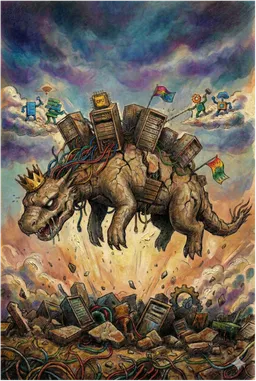
The thesis
The most serious problems in modern architecture are not technical, they are economic.
Slow deployments. Costs that grow without explanation. Systems so coupled that a small change cascades into failures. Brilliant teams paralyzed by technical bureaucracy. In software, monoliths have become the new totalitarian states. This book proposes the alternative: cloud architecture as cooperation among sovereign units instead of a mechanism of central control.
A new way to see your systems
-
Sovereign microservices
[Lens]
Autonomous economic units with their own data and explicit contracts, far from a technical fad.
-
Costs as signals
[Lens]
The cloud bill stops being a punishment and becomes actionable information.
-
Teams as actors
[Lens]
Conway's Law, Team Topologies and the inverse maneuver Spotify applied at scale.
-
Forensic observability
[Lens]
Chain of custody, correlation IDs and traceability to investigate incidents like a forensic expert.
10 chapters, 4 parts
From diagnosing the Leviathan to the digital rule of law, with real, documented cases: Knight Capital, Netflix Chaos Engineering, the Bezos mandate, Shopify pods and Dropbox's migration away from AWS.
- 01 The Digital Leviathan The inevitability of monolithic collapse.
- 02 Code Bureaucracy and Conway's Law How the org chart becomes the compiler.
- 03 The Division of Labor Adam Smith applied to software: from craftsman to assembly line.
- 04 Private Property and Data Sovereignty APIs as free-trade treaties between services.
- 05 Choreography and Spontaneous Order The free market of events. Killing the god service.
- 06 Embracing Uncertainty CAP theorem, eventual consistency and Sagas.
- 07 Price as a Signal The AWS bill as an X-ray of your architecture.
- 08 The Tragedy of Shared Resources Hardin, Ostrom and how to avoid the distributed monolith.
- 09 Observability as Forensic Science Logs, traces and metrics as evidence of a case.
- 10 Contracts, Least Privilege and the Digital Rule of Law The constitution of a distributed system.
Who is this book for?
- You've suffered large, expensive, rigid systems.
- You're an architect, tech lead, CTO or technical leader.
- You know the problem isn't the language or the framework.
- You sense something deeper is broken.
It's for you if
- A "Hello World" tutorial.
- A step-by-step AWS manual.
- Magic recipes without context.
- Technical diagrams disconnected from reality.
It's not for you if you're looking for
Not every software problem is solved by writing more code. Many are solved by understanding the story the data tells.
[From the author]
About the author

Jonhathan Rolando Rodas López
[Person]
Cloud architect · Tech lead · Forensics
Software developer and solutions architect with more than a decade designing scalable systems on AWS. Licensed in Police Sciences with a forensic specialization, and a Master's degree in Software Engineering and Management.
That uncommon combination (investigative rigor applied to distributed systems design) is the backbone of this book. In daily practice, systems aren't thought of as collections of services; they're thought of as cases that must be auditable, explainable and defensible.
Is your architecture a Leviathan or a free market?
If you've been building software for years and the question sounds familiar, this book is for you. Reach out directly to reserve your copy. The book is currently available in Spanish.
ISBN 979-8-2581-1571-3 · Published 2026